
Buying marble is not only about choosing a colour or finding a slab that looks beautiful in a showroom. Natural marble has its own patterns, veins and variations. Two slabs from the same lot may not look exactly the same.
This is why checking marble quality before buying matters. A closer inspection can help you understand the condition of a slab, compare different pieces and avoid surprises after purchase.
But there is one thing to remember. There is no single test that can tell you whether marble is good or bad. Surface finish, cracks, thickness, filling, colour consistency, processing and the quality of the complete lot all matter.
Here is a practical guide to help you understand how to check marble quality before making a purchase.
What Does Marble Quality Actually Mean?
Marble quality is a combination of several factors rather than one feature.
A good slab should have a finish that matches your expectations, acceptable natural characteristics and proper dimensions. It should also be processed well and have a condition that suits the project for which it is being purchased.
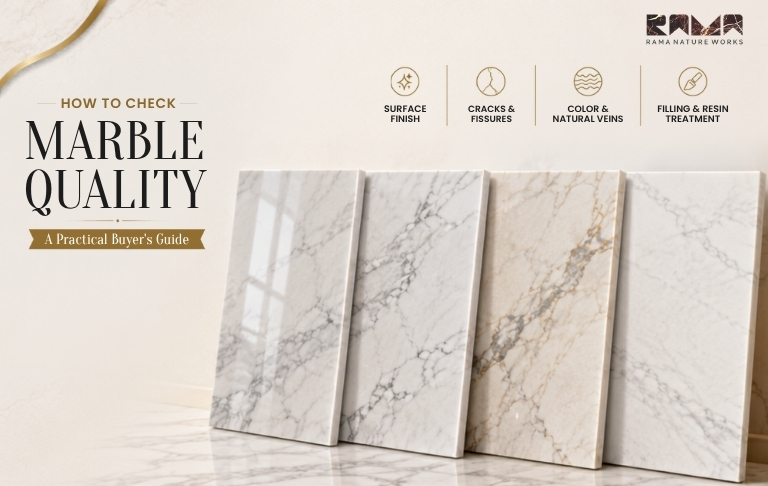
When checking natural marble quality, look at:
- Surface finish
- Cracks and fissures
- Colour and natural veins
- Filling or resin treatment
- Thickness and dimensions
- Edges and back side
- Consistency across multiple slabs
- Usable recovery
- Processing quality
Some properties such as water absorption, density and strength can also be checked through professional testing when project requirements call for it.
In simple terms, marble quality is not just about how a slab looks. It is about how well the material meets your expectations and project requirements.
What to Check Before Buying Marble
1. Inspect the Marble Surface
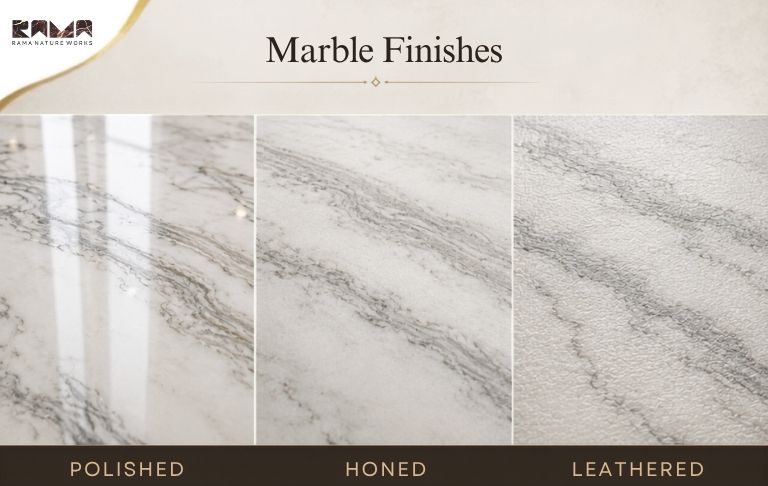
Start with a close look at the surface. Do not inspect marble only from a distance under bright showroom lights. Look at the slab from different angles and under suitable lighting.
Check for:
- Dull patches
- Uneven polish
- Visible scratches
- Waves or uneven areas
- Pinholes
- Processing marks
- Blurry or inconsistent reflection
A well-finished slab should have a consistent surface appearance according to its selected finish. If some areas look noticeably dull or different from the rest of the slab you should ask the supplier about them before buying.
Run your hand gently across the surface as well. You may notice uneven areas that are difficult to see from a distance.
This simple marble quality check can tell you a lot about surface and processing quality.
2. Check for Cracks and Fissures
Cracks and fissures deserve careful attention when inspecting a slab.
Look at both the front and back of the marble. Pay special attention to:
- Open cracks
- Hairline cracks
- Cracks near edges
- Cracks around veins
- Repaired areas
- Cracks visible from the back
However, do not assume that every line in natural marble is a crack.
A natural vein is not automatically a defect.
Natural stone can have different patterns and characteristics. The important question is whether a crack or fissure affects the usable area, handling, processing or expected performance of the slab.
If you notice a suspicious line ask the supplier whether it is a natural vein, a fissure or a repaired area.
3. Examine Colour and Natural Veining
Colour is one of the first things people notice when selecting marble. It is also an important part of slab selection.
Look at:
- Base colour
- Shade consistency
- Natural veins
- Unusual patches
- Spots
- Differences between slabs
Natural marble is not manufactured to look exactly the same in every piece. Some variation is part of its natural character.
The goal is not to find a slab with zero variation. Instead you should understand the variation and decide whether it matches the look you want.
This is especially useful when comparing marble quality in India because different marble varieties and sources can have very different natural characteristics.
If you are buying several slabs ask to see more than one piece together. A single slab may look very different from the rest of the lot.
4. Inspect Filling and Resin Treatment
Some marble slabs may have areas that are filled with resin or another suitable material during processing. Filling can be used to address natural pits, fissures or small openings and it does not automatically mean that the marble is poor quality.
The important thing is to understand:
- Where filling has been used
- How much filling is present
- Whether the repair is properly finished
- Whether filled areas are visually acceptable
- Whether the supplier can explain the treatment
Look at the slab closely under good lighting. Poorly finished filling may be easier to notice around veins, pits or repaired areas.
If you see significant filling ask the marble supplier about the processing rather than making a quick judgement based only on appearance.
5. Check Marble Thickness and Dimensional Consistency
Thickness is another important part of marble slab quality.
Do not assume that every marble slab has one universal thickness. Actual thickness can depend on the product specification, slab type and project requirements.
Before buying check:
- Actual thickness
- Thickness at different points
- Length and width
- Straightness of edges
- Squareness where relevant
- Consistency between slabs
If you are buying several slabs, compare them instead of checking only one.
Uneven dimensions can create difficulties during cutting and installation. For larger projects, dimensional consistency can also make planning and material use easier.
6. Inspect the Edges, Corners and Back
Many buyers focus only on the polished front surface. That can be a mistake.
Inspect the edges and back of the slab for:
- Chips
- Broken corners
- Hairline cracks
- Edge repairs
- Loose portions
- Visible damage
- Mesh or fibre reinforcement
If reinforcement is present do not immediately assume that the marble is poor quality. Ask why it has been used and understand the processing done on the slab.
Checking the back side can also help you spot damage or repairs that may not be obvious from the front.
Marble Quality Tests: What Can You Check Yourself?
Some simple observations can help during a preliminary inspection. However, they should not be treated as a replacement for formal material testing.
Water Absorption: A Useful Preliminary Check
Water absorption is a recognised physical property of natural stone. A simple water observation may help you notice whether a surface appears to absorb moisture quickly.
However, this should only be treated as a preliminary check.
Do not assume that:
Water absorbed quickly means the marble is automatically poor quality.
Natural stone varieties can have different physical properties. A proper marble quality test for absorption follows a standard testing method and controlled conditions.
For an important project you may need technical test data rather than relying on a simple showroom check.
What About Scratch, Sound and Acid Tests?
You may find scratch tests, tapping tests and lemon or acid tests in many online marble buying guides.
These methods should be treated carefully.
A scratch result does not by itself prove that marble is good or bad. A tapping sound cannot confirm the complete condition of a slab. Similarly a reaction to an acidic substance is not a complete quality test.
These simple checks may be discussed as common inspection practices but they should not replace proper testing.
The better approach is to use visual inspection for initial screening and rely on suitable professional testing when the project requires verified physical properties.
Don’t Judge Marble Quality From One Slab
This is one of the most useful things to remember when buying marble.
One attractive slab does not represent the entire lot.
Natural marble can vary from slab to slab. Before placing a large order try to inspect several pieces together.
Compare:
- Base colour
- Shade
- Veins
- Grain
- Whiteness
- Spots
- Filling
- Polish
- Thickness
- Overall appearance
Place slabs next to each other under suitable lighting. This gives you a much better idea of what the finished material may look like.
The goal is not perfect uniformity. Natural marble is not a mass-produced material with exactly the same pattern on every piece. The goal is to understand the natural variation and make sure it is acceptable for your expectations.
This simple step can make your marble slab inspection much more useful.
Check Usable Marble Recovery Before Buying
Price per square foot is important but it should not be the only number you consider.
The quantity you purchase is not always equal to the quantity that can be used.
Usable marble recovery can be affected by:
- Cracks
- Irregular edges
- Natural openings
- Cutting requirements
- Pattern matching
- Size limitations
- Areas that cannot be used
For this reason, ask how much usable material you can realistically expect from the slabs you are considering.
A marble with a lower quoted price may not always be the lower-cost option if more material is lost during cutting or selection.
Thinking about recovery also helps you understand possible marble wastage before the purchase is finalised.
Sample vs Actual Marble Slabs: What Should You Check?
A sample is useful when choosing marble. It helps you understand the basic colour, pattern and finish.
But a small sample cannot always show the complete natural variation of a large slab or an entire lot.
Before making a large purchase:
- Compare the sample with actual slabs.
- Inspect multiple slabs whenever possible.
- Check colour and vein variation.
- Look at the finish under suitable lighting.
- Confirm that the actual material matches your expectations.
This is particularly important for large projects where several slabs will be used together.
If the final material is significantly different from what you expected from the sample, discuss it with the supplier before proceeding.
Questions to Ask Your Marble Supplier Before Buying
A good supplier should be able to give you clear information about the material you are considering.
Ask questions such as:
- Where is the marble sourced from?
- What is the actual slab thickness?
- Can I inspect multiple slabs from the same lot?
- Has the marble been filled or resin-treated?
- What kind of processing and finishing has been done?
- What usable recovery can I expect?
- Can I compare the actual slabs with the sample?
- Are relevant technical test reports available if the project requires them?
Clear answers can make the buying process easier and help you compare different materials more fairly.
When Should Marble Be Professionally Tested?
A basic buyer inspection is useful for checking visible characteristics. It is not the same as professional testing.
For projects where material performance needs to be verified, professional testing may evaluate properties such as:
- Water absorption
- Density
- Compressive strength
- Flexural strength
- Modulus of rupture
- Abrasion resistance
The exact tests needed depend on the project and the material specification.
For a normal buyer, there is no need to turn a showroom visit into a laboratory inspection. But for large, high-value or specification-driven projects, technical test reports can provide useful information that simple visual checks cannot.
Marble Quality Checklist Before You Buy
Before finalising your purchase use this quick marble quality checklist:
- Surface finish checked
- Cracks and fissures inspected
- Colour and veins compared
- Filling or resin treatment checked
- Thickness measured
- Edges and corners inspected
- Back side checked
- Multiple slabs compared
- Usable recovery considered
- Sample compared with actual slabs
- Supplier questions answered
- Technical reports checked where appropriate
Taking a little extra time before buying can help you make a much more informed decision.
Explore Marble at Rama Nature Works
Choosing the right marble becomes easier when you can understand the material and compare actual slabs before making a decision.
Rama Nature Works offers a collection of Indian marbles and imported marbles for buyers looking to explore different natural stone options. You can learn more about available marble slabs and speak with the team about your material requirements.
Explore Marble Collection
Talk to Our Marble Experts
Conclusion
Good marble buying is not about finding the most beautiful slab in a showroom. It is about understanding what you are buying.
Inspect the surface carefully. Check cracks, fissures, filling, thickness and edges. Compare several slabs instead of judging one piece. Think about usable recovery and ask the supplier clear questions about sourcing and processing.
Simple checks can help you make a better first assessment but they should not be treated as a substitute for professional testing when technical verification is required.
Most importantly, take time to understand the natural variation in marble. When you know what to look for you can choose material with greater confidence and fewer surprises later.
Frequently Asked Questions
1. How do you check marble quality before buying?
Check the surface, cracks, colour, veins, filling, thickness and edges. Also compare multiple slabs before making a final decision.
2. What should you check before buying marble?
Check the slab’s surface finish, cracks, natural veins, filling, thickness, dimensions and back side. Compare several slabs from the same lot when possible.
3. How do you know if marble is good quality?
Good marble should have an acceptable surface finish, no serious damage and consistent dimensions. Natural colour and vein variation is normal.
4. Is water absorption a test for marble quality?
Water absorption is an important property of natural stone but a simple water-drop check is only a preliminary observation. Proper absorption testing follows a standard test method.
5. Should you check more than one marble slab before buying?
Yes. Checking multiple slabs helps you compare colour, veins, finish, thickness and natural variation across the lot.